


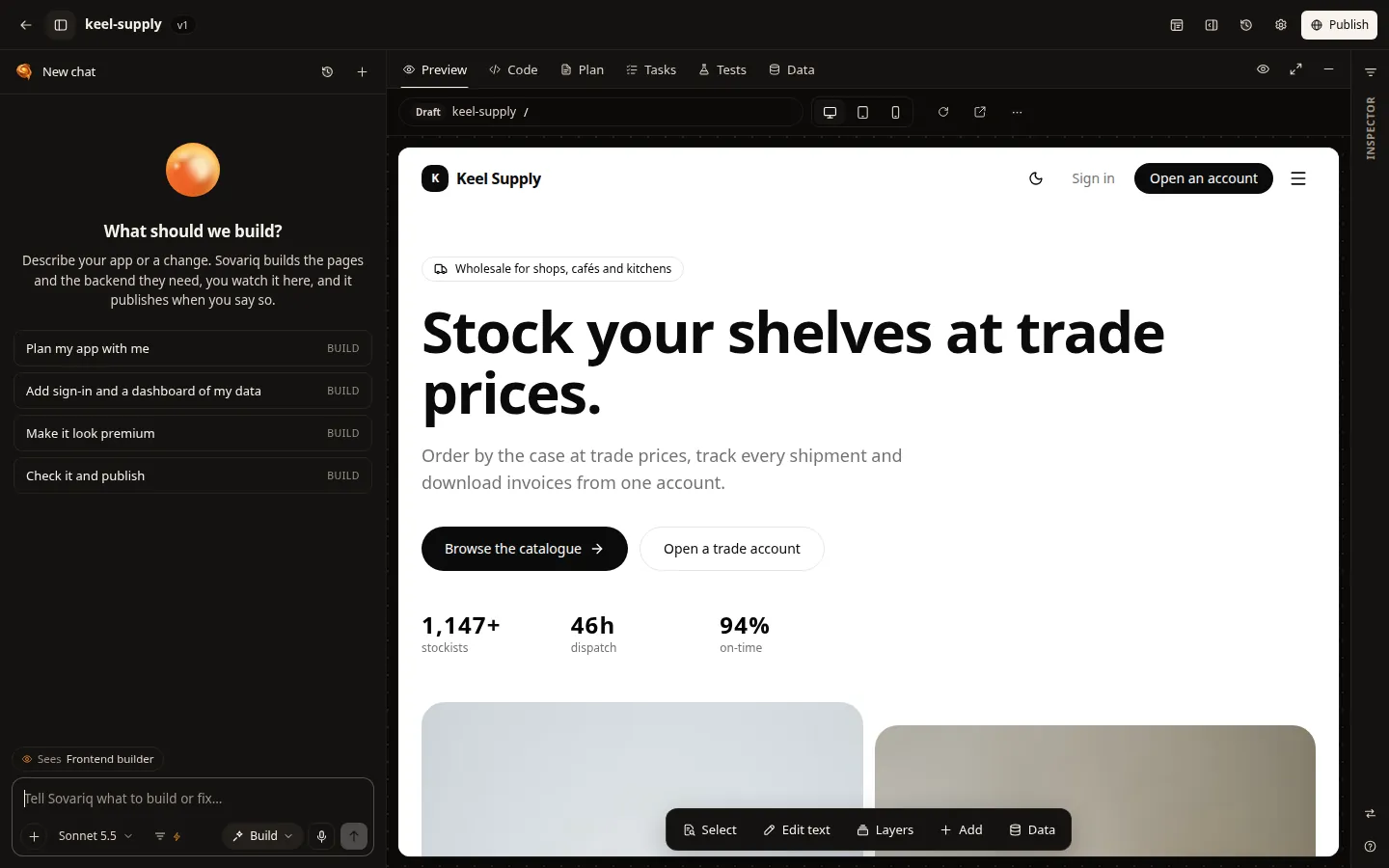
Build an ERP for my shop
22 tests passed
Sovariq builds the whole app
It plans the pages, builds tables, rules and functions, tests in a browser and publishes.
Learn more about Sovariq builds the whole app

Postgres, sign-in, storage, functions and realtime behind one API. Nothing reaches your data until it is identified and allowed, and every change runs on a copy first.


SDKS AND A CLI FOR THE STACK YOU ALREADY USE
An order inserted with the SDK reaches every phone that is listening. The same insert from a visitor is refused by the table’s row rule, with Postgres’s own error.
How row rules work Sample data from the recorded Keel Supply build.[{ "number": "SO-1049", "total_cents": 79200, "status": "submitted" }]{ "code": "42501",
"message": "new row violates row-level security policy for table \"sales_orders\"" }create policy "customer orders" on sales_orders for insert
with check (customer_email = auth.verified_email()
and status = 'submitted');A visitor’s order was refused by your rules. Nothing changed.
An order inserted with the SDK reaches every phone that is listening. The same insert from a visitor is refused by the table’s row rule, with Postgres’s own error.
How row rules work Sample data from the recorded Keel Supply build.// signed in as ops@junipercafes.com
const { data } = await sovaria
.from('sales_orders')
.insert({
number: 'SO-1049',
customer_email: 'ops@junipercafes.com',
lines: [{ product_id: 'KL-101', qty: 3 }],
total_cents: 79200,
status: 'submitted',
})
.select('number, total_cents, status')[{ "number": "SO-1049", "total_cents": 79200, "status": "submitted" }]// a visitor with the public anon key
await anon.from('sales_orders').insert({ number: 'SO-1050', … }){ "code": "42501",
"message": "new row violates row-level security policy for table \"sales_orders\"" }create policy "customer orders" on sales_orders for insert
with check (customer_email = auth.verified_email()
and status = 'submitted');A visitor’s order was refused by your rules. Nothing changed.
Ten layers stand between a request and your data, in this order. This is the console’s own view of them, with each layer’s live setting.


Ten layers stand between a request and your data, in this order. This is the console’s own view of them, with each layer’s live setting.
The latest pieces, each shown on the console screen it lives on.
See the changelogIt plans the pages, builds tables, rules and functions, tests in a browser and publishes.
Learn more about Sovariq builds the whole app

A support agent that answers from your docs, a morning digest, a chat with memory.
Learn more about Agents inside your app

Give or take a role and it applies within seconds, even to tokens already issued.
Learn more about App roles you can change live

Call the same function by its name or its stable id, pinned to a version.
Learn more about Functions by name or id

Large files go up in chunks and carry on from where a dropped connection left off.
Learn more about Uploads that resume

Who is online, in every SDK, with join and leave updates and limits staff can tune.
Learn more about Presence everywhereEcho checks a policy or SQL change on a copy, so you see who gains or loses access before it ships. Chrono keeps every version of your schema, rules and functions, and table history lets you query a table as it was at any moment.
See how simulation worksALLOW IF ctx.resource.name == "orders"ALLOW IF ctx.resource.name == "orders" AND ctx.actor.user_id == ctx.resource.owner_idSELECT * FROM sov_as_of(NULL::orders, '2026-10-09 15:30');
5 rows · 3 columns · read-only snapshot of add two orders
ALLOW IF ctx.resource.name == "orders"ALLOW IF ctx.resource.name == "orders" AND ctx.actor.user_id == ctx.resource.owner_idSELECT * FROM sov_as_of(NULL::orders, '2026-10-09 15:30');
5 rows · 3 columns · read-only snapshot of add two orders
A branch is a copy of your schema and migrations, functions, policies and settings, with a checkpoint of the data if you want it. Personal columns arrive masked.
Same row, same shape, joins still work. The real name, email and card never leave production.
Tables, rules, functions and settings changed on the branch are recorded one by one, with a diff for each, and any of them can be undone.
Deploy to staging, then production; every change is checked on a copy first. Snapshots keep a point you can go back to, with the database too.


A branch is a copy of your schema and migrations, functions, policies and settings, with a checkpoint of the data if you want it. Personal columns arrive masked.
Same row, same shape, joins still work. The real name, email and card never leave production.
Tables, rules, functions and settings changed on the branch are recorded one by one, with a diff for each, and any of them can be undone.
Deploy to staging, then production; every change is checked on a copy first. Snapshots keep a point you can go back to, with the database too.

 App roles and user adminsSign-in and accessYour own roles (MANAGER, REP…) for your app’s users, read by your row rules.

 FunctionsFiles, code and realtimeServer code in Python, JavaScript, TypeScript or Go, called over HTTPS.

 Remote config and experimentsMobile and growthChange how your app behaves without a new release, and test it on a share of users.SovariqAIAn AI engineer in the console that plans a change, asks before it writes and checks the result.

 ImportsRun and moveMove a Supabase, Firebase, Convex or Postgres project with one command.
sov import supabase
 Access policiesSign-in and accessRules checked on every request with default deny, on top of row-level security.

 FlowsFiles, code and realtimeAutomations built from a trigger and steps on a canvas in the console, run on your backend.RealtimeFiles, code and realtimeChannels, presence and live database changes over WebSockets.

 Tester buildsMobile and growthShare APK and IPA builds with invited testers before they ship.Agents in your appAIAI agents your users talk to, with tools that run under your access rules.

 Audit logRun and moveAn append-only, hash-chained record of important actions.


 Enterprise sign-inSign-in and accessLet your customers’ companies sign in with their own identity provider.

 Version historySign-in and accessA timeline of every change to policies, tables, functions, settings, buckets and keys.

 Push and messagingMobile and growthPush and email to your app’s users from one API.

 App builderAIReact apps built on your backend, previewed live, tested in a browser and published.

 Organizations and environmentsRun and moveOrganizations, projects, team roles, and staging next to production.


 Simulation and rules testsSign-in and accessSee who can read and change what before a rule or schema change ships.

 Background workFiles, code and realtimeRun code on a schedule, on an event, or from a queue.

 Analytics, crashes and performanceMobile and growthProduct events, crash reports and app performance in the console.

 Hosted MCP serverAIConnect Claude, ChatGPT, Cursor or VS Code to your project at api.sovaria.in/mcp.
https://api.sovaria.in/mcpCompliance centerRun and moveEvidence for your own audits, built from the live platform when you download it.IntegrationsRun and moveSlack, GitHub, Vercel, AI providers, email providers, Zapier and log drains.
 AuthenticationSign-in and accessSign-in for your app’s users, with sessions you control.

 StorageFiles, code and realtimeFile buckets with per-folder access rules, public and signed URLs.

 Mobile SDKsBetaMobile and growthNative SDKs for Flutter, Swift and Kotlin, with sign-in, data, storage and realtime.

 Sovariq for ChromeBetaAISovariq in a Chrome side panel, beside the page you are working on.Logs, traces and alertsRun and moveAPI, auth, database and function logs with a trace for every request.


Each engine does one job and is reached only through the gateway. Hover an engine to light up everything it connects to.
Read the engine referenceEvaluates SPL policies with default-deny semantics. Nothing executes without an explicit ALLOW.
The sov CLI and five SDKs (TypeScript, Python, Dart, Swift and Kotlin) follow the same rules as the console. Every command and line of output here is real sov CLI output, beside real SDK code.
See the SDKs and the CLI$ npm install -g @sovaria/cli$ npm install @sovaria/sdk$ pip install sovaria-sdkWhat changes when identity, policy, data and simulation live in one place.
Security is part of the request path, not an add-on. These behaviors come from how the gateway, Guard and the SDKs are built.
How Sovaria keeps data safeFixed monthly prices with published overage rates. Every plan includes the full engine suite.
See full pricingStraight answers about how the platform works, how it keeps data safe and what it costs. For anything else, the docs go deeper.
Browse the docs Compare with Supabase, Firebase, Convex and NeonSovaria is a backend platform for web and mobile apps: every project gets a Postgres database, user sign-in, file storage, server functions, realtime, a JSON document store and vector search behind one API, plus Sovariq, an AI engineer that builds and runs the backend with you.
Like Supabase, each project has Postgres with row-level security, and supabase-js works against it. Like Firebase, it has JSON document collections with a Firestore-style API. On top of that, every request passes access rules with default deny, you can simulate a change to see who gains or loses access before it ships, and any change can be undone from the project timeline. The comparison pages go through each one in detail.
Your app calls your project URL. Sovaria identifies the caller (a signed-in user, the public anon key or a server-only service key), checks your access policies and row-level security, runs the work in the database, storage, functions or realtime, and records usage and important actions in the audit log.
The JavaScript and TypeScript SDK (@sovaria/sdk), the Python SDK, Flutter, Swift and Kotlin SDKs for mobile apps, the sov CLI and a plain HTTP API. supabase-js also works for tables and RPC, and the Firestore-style API keeps Firebase code working.
Yes. Postgres tables and JSON document collections live in the same project, behind the same sign-in and the same access rules, so there is nothing to keep in sync.
Simulation checks who can do what (visitors, signed-in users, each app role and your team) across tables, documents, storage, realtime and functions without writing any data, and previews a policy or schema change on a copy of the project. Run it in the console, or with sov sim run in CI to stop a deploy that would expose data.
Yes. Version history records every change to policies, tables, functions, settings, buckets and keys, so you can undo one change or take the project back to an earlier point, and table history lets you query rows exactly as they were at any moment.
Access policies decide whether a caller may use a table, bucket, channel or function, and Postgres row-level security decides which rows. Both default to deny: without an explicit allow, nothing runs.
Every request carries its organization, project and environment, requests without them are refused, and keys are scoped, so a key for one environment cannot read another. Paid plans get a dedicated Postgres database.
Yes. The audit log is append-only and hash-chained: each record carries the hash of the one before it, and sov audit verify checks the whole chain for tampering.
Yes. Free costs nothing and needs no card: 1 project, 500 MB database, 5,000 MAU, 1 GB files, 2 GB bandwidth, paused after 7 days without activity, with every product turned on. It stops at its limits instead of billing.
Pro $29 (₹2,599 in India), Ultra $99 (₹9,999 in India), Team $599 (₹49,999 in India) a month, and Enterprise is a custom contract. Customers billed in India pay the fixed rupee prices, by UPI or card. Every plan includes every product; plans differ in allowances, seats and support, and usage past an allowance is billed at published rates.